
Coagulation & Flocculation
Chemical destabilisation of colloidal particles and floc formation for effective solid-liquid separation.
What Are Coagulation and Flocculation?
Coagulation is the neutralisation — the destabilisation — of the surface charge of colloidal pollutants in wastewater by adding chemicals (coagulants). Flocculation is the step in which those destabilised particles are brought together under slow mixing, with the help of a polymer (flocculant), into large, separable flocs. Together the two processes are the chemical basis for the removal of suspended solids (TSS), turbidity, colour, phosphorus, oil and grease, and heavy metals.
The critical point is this: coagulation-flocculation on its own removes nothing from the water — it only makes the pollutant separable. The actual separation happens in the stage that follows: DAF (flotation) or settling. The better the chemical conditioning, the smaller and more efficient the DAF or clarifier can be; if the chemistry is wrong, even the best equipment cannot save the plant.
The purpose of this article is not to sell but to explain: why colloids do not settle by themselves, what zeta potential measures, why rapid and slow mixing are separate, and why the right dose can only be found with a jar test. The numerical ranges given are typical orders of magnitude found in the literature; the exact recipe for each plant is established by wastewater analysis and jar testing.
Looking for what comes next? This page explains chemical conditioning. For the stage in which the flocs are separated by flotation: GESU DAF systems → · Technology summary page: Coagulation & Flocculation technology · Jar testing and process design: How We Work
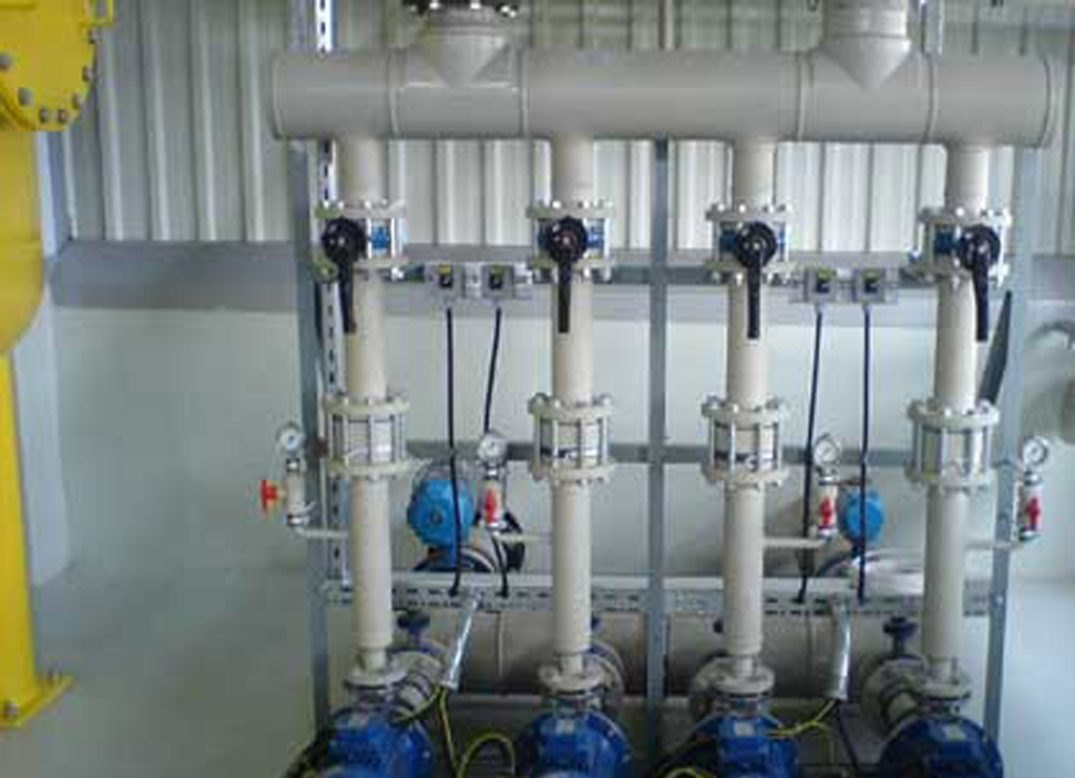
Working Principle
Coagulant selection
PAC, FeCl₃, Al₂(SO₄)₃ — the most suitable coagulant for the wastewater characteristics is determined by jar test.
Polymer dosing
Floc growth with anionic, cationic or non-ionic polymer. Automatic make-up unit included.
Jar test support
Jar tests are run in the GESU laboratory to establish the optimum chemical and dose.
Why Doesn't a Colloid Settle? Zeta Potential and Destabilisation
A colloidal particle can stay suspended in water for days. The reason is not its weight but its charge. The whole engineering of coagulation-flocculation is the control of the following four steps.
Zeta potential — the measure of repulsion
The surface of colloids is generally negatively charged; every particle gathers a cloud of ions around it (the electrical double layer). The potential of that cloud at the shear plane is called the zeta potential — the practical measure of electrostatic repulsion between particles, typically in the order of −10 to −30 mV for wastewater colloids. Because of this repulsion, particles cannot stick together even when they collide: the suspension is “stable” and will never settle on its own.
Destabilisation — charge neutralisation and sweep floc
When the coagulant (iron/aluminium salts, PAC) enters the water it forms positively charged hydrolysis products. These work through two mechanisms: charge neutralisation — the positive species attach to the negative surface and bring the zeta potential close to zero (a typical target of about 0 ± 5 mV); and sweep flocculation — at a sufficient dose the bulky metal hydroxide precipitate that forms traps the colloids like a net and sweeps them out. Dose and pH decide which mechanism dominates.
Rapid mixing — homogeneous dispersion within seconds
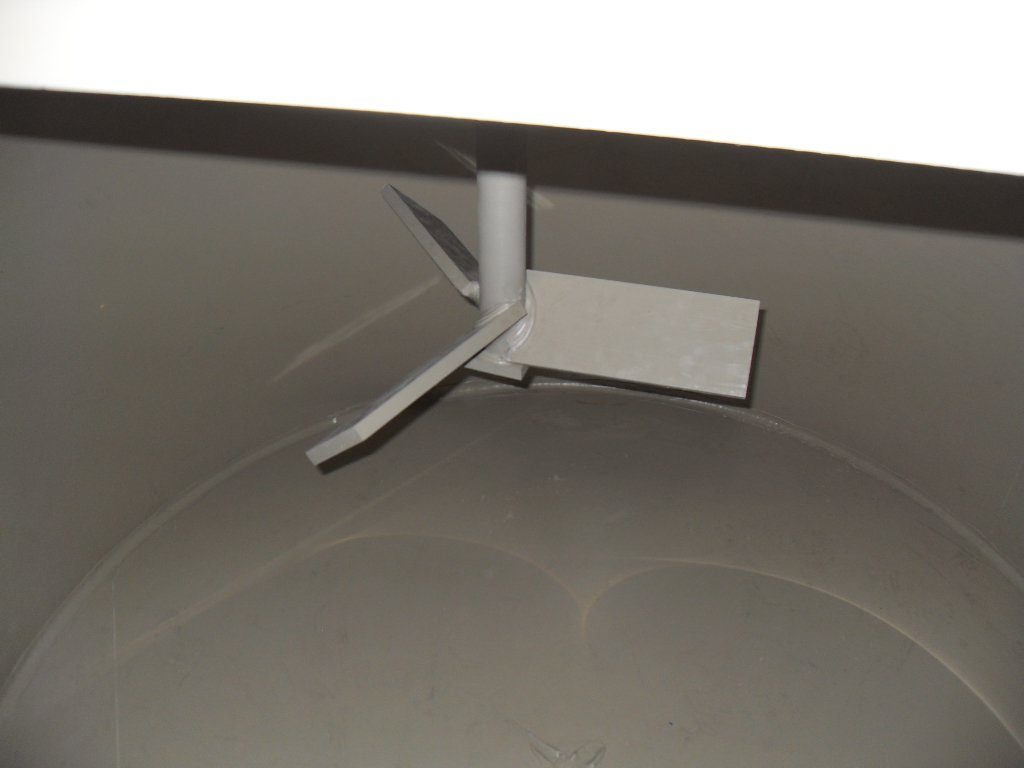
Coagulant hydrolysis products form within seconds and are reactive; the chemical must spread through the whole volume the moment it enters the water. That is why high-energy, short-duration mixing is applied at the dosing point: the literature gives a typical G value (velocity gradient) of about 300-1000 s⁻¹ over about 30-120 seconds. If dispersion is delayed, part of the chemical is wasted in a locally overdosed zone while the remaining volume stays underdosed.
Slow mixing — bridging and floc growth
Destabilised particles only grow if they are collided gently. In the slow mixing stage (typical G of about 20-80 s⁻¹ over about 15-45 minutes) long-chain polymer (flocculant) builds bridges between particles and forms visible, separable flocs. Energy here is not an enemy but a balance: too little and there are no collisions, too much and the newly built floc is torn apart again — and a broken floc never re-forms as easily as the original.
The physics in short: coagulation-flocculation is a quartet of the right chemical + the right dose + the right pH + the right mixing energy. Almost every problem in the field starts when one of these four drifts — and all four can be verified on the bench with a jar test.
Jar Test: the Recipe Is Written on the Bench
Which coagulant, which dose, which pH? The answers do not come from a catalogue but from a jar test run with your own wastewater. The test imitates the full-scale plant in a row of beakers.
Dose sweep
Samples taken from the same wastewater receive increasing coagulant doses; the sequence rapid mix → slow mix → settling/flotation is followed. Floc size, formation speed and the clarity of the supernatant are compared.
pH sweep
Around the best dose, the pH is now varied; every coagulant has a different effective window. Since metal salts lower the pH as they are dosed, the need for pH adjustment (neutralisation) also emerges at this step.
Measurement and decision
Turbidity/TSS/COD are measured in the supernatant; polymer type and dose are trialled. The combination that meets the target effluent with the lowest chemical consumption is recorded as the operating recipe.
A jar test is not a static document: when raw materials, the production recipe or the season change, the wastewater changes with them, and the test must be repeated periodically. GESU carries out jar testing and the chemical conditioning design based on it as part of its engineering and project work.
Design and Operating Parameters
A coagulation-flocculation unit is sized and operated with these parameters. The values are typical ranges found in the literature; the exact recipe is established by wastewater analysis and jar test.
| Parameter | What It Expresses | Typical Range (literature) | What It Affects |
|---|---|---|---|
| Rapid mixing G value | Mixing intensity (velocity gradient, s⁻¹) | Typically ~300-1000 s⁻¹ | Instant, homogeneous dispersion of the coagulant |
| Rapid mixing time | Contact time at the dosing point | Typically ~30-120 s | Too short means poor dispersion, too long means wasted energy |
| Slow mixing G value | Mixing intensity in the flocculation stage | Typically ~20-80 s⁻¹ | The balance between floc growth and floc break-up |
| Flocculation time | Retention time in the slow mixing tank | Typically ~15-45 min | Floc size and the efficiency of the separation stage |
| Coagulant dose | Coagulant added per unit volume (mg/L) | Varies with the wastewater (jar test) | Removal efficiency and the amount of sludge produced |
| pH window | The pH range in which the coagulant works effectively | Typically ~5.5-7.5 (Al), ~5-8.5 (Fe) | Floc formation; outside the window performance collapses |
| Polymer dose (water line) | Flocculant (mg/L) | Typically ~0.1-2 mg/L | Bridging; an excess creates sticky flocs and carry-over problems |
| Zeta potential target | The measure of destabilisation | Typically ~0 ± 5 mV | Underdosing = repulsion persists; overdosing = charge reversal |
All values in the table are typical literature orders of magnitude, not commitments; the final recipe and sizing are produced from wastewater analysis + jar test. The G value is a design quantity calculated from mixer power, tank volume and water viscosity.
How Is It Used in Each Sector?
Coagulation-flocculation is the first chemical step of almost every industrial treatment plant; what changes is the target pollutant and the separation stage behind it. The approaches below are typical tendencies.
| Sector | Target Pollutant | Typical Chemical Approach | Separation Stage |
|---|---|---|---|
| Food & Beverage | Oil and grease, TSS, particulate COD | Coagulant + anionic polymer | DAF |
| Slaughterhouse / Integrated Meat | Blood, fat, protein colloids | pH adjustment + coagulant + polymer | DAF |
| Textile & Dyehouse | Colour, dye colloids, TSS | Iron salt/PAC + polymer, tight pH control | DAF or settling |
| Metal & Plating | Heavy metals (Cr, Ni, Zn, Cu...) | pH increase (hydroxide precipitation) + coagulant + polymer | Lamella clarifier |
| Pulp & Paper | Fibre, filler, TSS | Coagulant + polymer | DAF |
| Dairy & Cheese | Fat, protein, TSS | pH adjustment + coagulant + polymer | DAF |
| Chemical / Pharma | TSS, colloids, upfront COD | A water-specific recipe from the jar test | Settling or DAF |
Note: the table shows typical configurations, not commitments. The exact chemical selection and flow scheme are established by laboratory analysis and jar test.
Typical Removal Efficiencies
The rates are typical orders of magnitude in the industry; the real efficiency depends on the wastewater character, the chemical selected and the separation stage behind it (DAF/settling), and is predicted by jar test.
Operating Tips
A coagulation-flocculation line looks simple, but its performance is re-earned every day. Five basic habits:
Don't put the jar test on the shelf
When raw materials, the recipe or the season change, the wastewater changes too. Repeating the jar test periodically (and at every drop in performance) keeps the dosing recipe tied to the real water; a line that has been running on the same dose for months is most likely either underdosed or overdosed.
pH first, dose second
If you are outside the pH window, no dose will save you. When performance drops, the first place to look is the pH probe and its calibration; increasing the dose is very often exactly the wrong reflex.
Calibrate the dosing pumps
Even if the recipe is right, the dose is wrong if the pump is delivering the wrong amount. Periodic calibration of the dosing pumps (measuring the actual flow with a graduated cylinder) and tracking the chemical tank level is the simplest quality assurance there is.
Prepare and mature the polymer correctly
Powder or emulsion polymer must be dissolved at the recommended concentration and given a maturation time for its chains to unfold; freshly mixed polymer performs poorly. Do not keep the prepared solution too long either — its activity falls over time.
Learn to look at the floc, and keep records
The size of the floc in the flocculation tank, the clarity and the settling/floating behaviour are the fastest process indicators; an experienced operator catches the problem by eye before the analysis result arrives. Records of pH, dose, flow and effluent quality are the only foundation for root-cause analysis.
Common Operating Problems and Their Remedies
The five conditioning problems most frequently encountered in the field, with their symptoms and probable root causes.
1. No floc forms at all
Symptom: chemical is being dosed but the water stays turbid and there is no visible floc. Probable cause: operating outside the pH window, the wrong coagulant type, an insufficient dose, or a fault in the dosing pump/line (the chemical is not actually reaching the water). Approach: first verify the pH and that the pump is really delivering; then re-run a jar test to sweep dose and chemical type.
2. Turbidity returns as the dose is increased — overdosing
Symptom: the effluent improves up to a point, then becomes turbid again as the dose rises. Probable cause: charge reversal (restabilisation): excess cationic coagulant turns the surfaces positive and the particles repel one another again. Approach: pull the dose back to the jar-test optimum; if the flow varies, tie dosing to flow-proportional (or flow-paced) control.
3. Pinpoint floc — pinhead-sized flocs, turbid effluent
Symptom: small, scattered flocs form but do not grow; a fine turbidity persists in the effluent. Probable cause: missing or wrong-type polymer, insufficient flocculation time, or an unbalanced slow-mixing energy. Approach: sweep polymer type and dose by jar test; check the flocculation time and the mixer speed.
4. The floc looks good in the tank but falls apart in the separation stage
Symptom: there are large flocs in the flocculation tank, yet the DAF/clarifier outlet is still poor. Probable cause: floc break-up (high turbulence) in the pump, valve or drop structure between the tank and the separation unit. Approach: convey the conditioned water by gravity and over a short run wherever possible; if it must be pumped, choose low-shear solutions and move the polymer dosing point closer to the separation unit.
5. Sticky, watery sludge — excess polymer
Symptom: the sludge is difficult to dewater, a sticky film forms on equipment surfaces and the filtrate is turbid. Probable cause: polymer overdosing (excess polymer gels the water and blinds the filter cloths) or the wrong polymer class. Approach: reduce the polymer dose step by step while monitoring filtrate quality; run a separate polymer optimisation for the dewatering line.
The GESU Difference
Related Solutions & Detail Pages
GESU DAF Systems
Separating conditioned flocs by flotation with micro-bubbles — GESU's flagship product.
Coagulation Technology Page
The summary technology page for coagulation within the chemical treatment family.
Sludge Treatment & Dewatering
Conditioning and dewatering of the chemical sludge produced by coagulation.
Engineering & Jar Test
Jar testing, chemical selection and conditioning line design — how we work.
Slaughterhouse & Meat Processing
Conditioning of blood, fat and protein colloids ahead of DAF — GESU's flagship sector.
Ask for a Conditioning Proposal
Get in touch with your wastewater analysis; we will verify it with a jar test and build the recipe together.
Let's Talk About Your Project
With 30 years of experience, let's define the most suitable solution for your project together.
Coagulation & Flocculation — Technical FAQ
These are the questions engineers ask us most often. If you can't find the answer you're looking for, get in touch with us.
What is zeta potential and why is it the yardstick in coagulation?
Because of the (usually negative) electrical charge on their surface, colloidal particles carry a cloud of ions around them in water; the potential of that cloud at the shear plane is called the zeta potential, and it is the practical measure of the electrostatic repulsion between particles. Wastewater colloids typically show distinctly negative values (for example in the order of −10 to −30 mV); because of this repulsion the particles cannot stick together even when they collide, and they never settle. The aim of coagulation is to bring the zeta potential close to zero (a typical target of about 0 ± 5 mV); once the charge is neutralised, the particles can hold on to one another through van der Waals forces.
What is the difference between coagulation and flocculation?
Coagulation is the chemical step: under rapid mixing, the coagulant that is added (iron/aluminium salts, PAC) neutralises the surface charge of the colloids within seconds and makes the particles “able to stick”. Flocculation is the physical step: under slow mixing, the destabilised particles collide and, bridged by polymer (flocculant), grow within minutes into visible flocs. The two steps require different mixing energies and different residence times, which is why they are designed as separate stages.
How is a jar test run and what does it tell you?
Samples taken from the same wastewater are placed in a series of beakers; each beaker receives a different coagulant dose (and/or a different pH). The sequence imitates the full-scale plant: a short rapid mix, then a long slow mix, then settling (or an observation of flotation to simulate DAF). At the end, the turbidity/COD of the supernatant is measured; floc size, formation speed and settling behaviour are observed. The combination that gives the best effluent at the lowest dose becomes the operating recipe. As the character of the wastewater changes, the jar test must be repeated periodically.
Why are rapid and slow mixing separate stages?
Rapid mixing (a typical G value of about 300-1000 s⁻¹ for about 30-120 seconds) exists to disperse the coagulant into the water instantly and homogeneously; because the coagulant hydrolysis products form within seconds, any delay reduces the efficiency of the dose. Slow mixing (a typical G of about 20-80 s⁻¹ for about 15-45 minutes) exists so that the flocs collide and grow without being broken up. If the energies are applied the wrong way round, both steps fail: a slow start means poor dispersion, and continued rapid mixing means broken flocs that will not settle. The values are typical orders of magnitude found in the literature.
Why does overdosing the coagulant reduce performance?
If a cationic coagulant is dosed beyond what is needed, the particle surfaces become positively charged instead (charge reversal / restabilisation); the particles repel one another again and the turbidity comes back. Excess metal salt can also lower the pH of the water and push it outside the coagulation window, and it increases the sludge volume. “More chemical = better treatment” does not hold; the optimum dose is found for each wastewater by jar test and is updated as the wastewater changes.
How does pH affect coagulation?
Every coagulant has a pH window in which it works effectively: the literature gives typical figures of about 5.5-7.5 for aluminium salts and about 5-8.5 for iron salts (varying with the target pollutant). Outside the window, the metal hydroxide floc either does not form properly or redissolves, and performance collapses. Metal salts are also acidic in character, so they lower the pH as they are dosed — which is why pH adjustment (neutralisation) and coagulation are designed together, and why a pH sweep is run alongside the dose sweep in the jar test.
PAC, ferric chloride or alum — which coagulant should be chosen?
There is no universal “best coagulant”. PAC (polyaluminium chloride) is a widespread choice because of its wide pH range, its good performance at low temperature and the fact that it depresses pH less; ferric chloride is strong in sulphide binding, phosphorus removal and some colour applications; alum (aluminium sulphate) is the classic, long-established option. The selection is made by jar-test comparison according to the character of the wastewater, the target pollutant and the amount of sludge produced — trust the test on your own water, not the catalogue.
Anionic or cationic — how is the polymer (flocculant) selected?
The polymer is chosen according to the surface charge of the flocs. Since particles are generally neutral or slightly positive after coagulation, an anionic polymer usually does the bridging on the water line; for dewatering negatively charged biological sludge, a cationic polymer is common; non-ionic types are used for intermediate cases. Molecular weight and charge density affect floc size and strength. On the water line the typical polymer dose is in the order of 0.1-2 mg/L (typical); the correct type and dose are determined by jar test and field trial. Correctly maturing the polymer (the make-up time) is also part of the performance.