
DAF or Sedimentation?
Both processes carry out solid-liquid separation; one floats the pollutant, the other settles it. Which one should you choose, and when? A scenario-based engineering guide.
One of the most basic tasks in wastewater treatment is separating the solids and the oil from the water. There are two classic ways of doing this: settling the particle to the bottom (sedimentation) or bringing it up to the surface with micro air bubbles (flotation — DAF). Both are processes proven over decades; the question is not which one is "good", but which one suits your wastewater.
The decision actually comes down to a single question of physics: is the particle heavier or lighter than water? Sand and heavy inorganic flocs settle readily. Oil droplets, fibres, dyes and colloidal particles either settle very slowly or not at all — instead of waiting for them, they have to be floated. In this article we compare the two processes against engineering criteria and then give a scenario-based decision guide. For the fundamentals of DAF technology, see our What Is DAF? guide; for product and sector detail, see the GESU DAF Systems page.
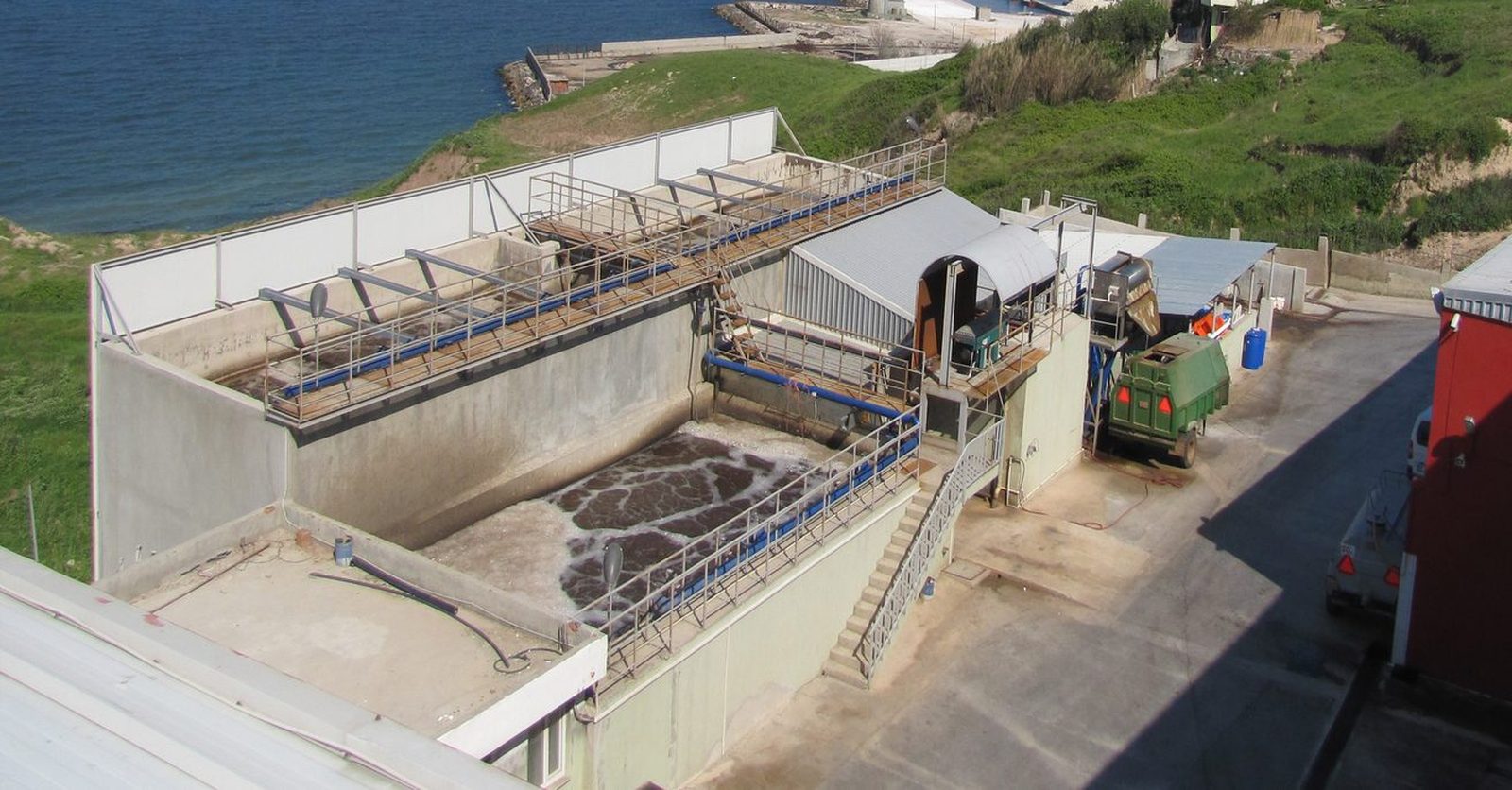
Two Processes, Two Directions
DAF: Separation by Flotation
Part of the effluent is saturated with air at a typical pressure of 4-6 bar; when this water is released to atmospheric pressure in the flotation tank, micro-bubbles with a typical diameter of 30-50 microns are formed. The bubbles attach to pollutants that have been flocculated beforehand with coagulant and polymer; the floc-bubble pair becomes lighter than water and rises to the surface within minutes. The sludge at the surface (the float) is removed by a mechanical skimmer.
- Total tank retention time typically 10-30 minutes (flotation zone 5-15 min)
- Surface loading typically 4-10 m³/m²·h
- Flotation sludge typically 2-5% dry solids
Sedimentation: Separation by Gravity
The water is slowed down in a quiescent basin; particles heavier than water sink to the bottom under gravity. The sludge at the bottom is collected into the conical zone by a scraper, and the clarified water overflows the weir at the top. Inclined plate (lamella) clarifiers are the proven way of doing the same job in a smaller area. It is a simple, low-energy, robust process — provided the particle really does settle.
- Retention time typically 2-4 hours
- Surface loading typically 0.5-1.5 m³/m²·h
- Settled sludge typically 0.5-1.5% dry solids
The values are typical ranges from the general engineering literature; design values are determined according to the wastewater character.
Side by Side
| Criterion | DAF | Sedimentation |
|---|---|---|
| Direction of separation | Upwards — flotation | Downwards — settling |
| Surface loading (typical) | 4-10 m³/m²·h | 0.5-1.5 m³/m²·h |
| Retention time (typical) | 10-30 minutes (total tank; flotation zone 5-15 min) | 2-4 hours |
| Space requirement | Small; skid/packaged delivery possible | Large; usually a reinforced concrete basin (reduced with lamella plates) |
| Sludge dry solids (typical) | 2-5% (float) | 0.5-1.5% |
| Pollutants it is strong on | Oil & grease, fibre, dye, colloids, light flocs | Sand, heavy inorganic solids, dense chemical flocs |
| Energy consumption | Higher (pressurisation pump, compressor) | Low (scraper drive only) |
| Mechanical complexity | More equipment: saturation vessel, pump, nozzle | Simple: basin + scraper |
| Response to flow fluctuation | Recovers within minutes | More sensitive to hydraulic shocks, takes long to stabilise |
This is a general engineering comparison; the plant-specific selection is made with a wastewater analysis and an engineering study.
Which One, When?
The six scenarios we meet most often in the field, and the engineering answer:
If your wastewater is oily
Slaughterhouse, dairy, vegetable oil, catering, metalworking emulsion... Oil is lighter than water; trying to settle it is rowing against physics. In every wastewater where oil & grease is significant, the first candidate is DAF.
If your solids are heavy and coarse
Sand, soil, mining solids, heavy metal hydroxide flocs (after chemical precipitation), glass and ceramic particles... For a rapidly settling particle, the simplest and most robust solution is gravity.
If your space is tight
If you are adding to an existing plant or the available plot is limited, the many times higher surface loading of DAF becomes decisive: the same flow, a much smaller footprint. A skid-type DAF can be commissioned without going into reinforced concrete basin construction. As an intermediate solution, a lamella clarifier can also be considered.
If it is a high-flow municipal plant
In municipal wastewater, primary and secondary clarifiers have been the standard for decades: the particles are settleable, the energy demand is critical and the flows are large. Here DAF comes onto the agenda only in special cases (e.g. surface water treatment with an algae problem, or tertiary polishing).
If your flocs are light and fragile
Textile dye, paper fibre, biological sludge flocs and colloidal structures drift for hours in a clarifier and escape over the weir. Micro-bubbles carry these light flocs upwards quickly; in paper mills, fibre recovery comes as a bonus.
If the wastewater has a mixed character
In waters that contain both heavy solids and oil — such as central treatment plants of organised industrial zones — the two processes are not rivals but team-mates: a grit trap/clarifier at the front removes the heavy solids, and the DAF collects the oil and the light flocs. The right flow scheme is worth more than picking a single "winner".
The golden rule: Make the decision in the laboratory, not from a catalogue. A settling test and a jar test carried out on a sample of the wastewater will show in a single day which process really works on your water. GESU carries out these tests in its own laboratory as part of the evaluation that precedes a proposal.
The Difference That Shows Up Downstream: Sludge
The comparison does not end at the separation tank. DAF float typically leaves the unit at a higher dry-solids content than settled sludge, which means there is less free water to remove in the dewatering stage and a smaller sludge volume to handle. Sedimentation, on the other hand, wins on the energy side: apart from the scraper drive it has practically no rotating equipment, while DAF has to keep a pressurisation pump and a compressor running.
The chemical demand is similar in both processes in most cases; the coagulant/polymer requirement is set not by the process but by the wastewater itself. The conclusion: the two technologies are compared over the whole life of the plant — separation performance, footprint, energy, sludge and operating simplicity together — not over a single criterion. If you would like a comparison for your own wastewater, the fastest starting point is the DAF engineering guide plus a jar test on your own sample.
Explore Further
Let's Talk About Your Project
With 30 years of experience, let's define the most suitable solution for your project together.