
Industrial Zone & Industrial Park Common Wastewater Treatment
The wastewater of an organized industrial zone is not the effluent of one industry but the mixture of dozens of different production lines: its flow swings with the shifts, its load with every new tenant. Two layers solve the job — each company runs its own pre-treatment, the central plant gathers up the mixed load. Our own factory sits inside an industrial zone; we know this reality from the inside.
How is industrial zone common wastewater treated? The wastewater of an organized industrial zone is a mixture of different production lines; its flow and pollution load change through the day and from company to company. The correct set-up has two layers: (1) every company installs the pre-treatment needed to meet the sewer connection (discharge) limits before releasing its wastewater into the zone's sewer; (2) the zone's central treatment plant brings this mixed load down to the receiving-water discharge standard through physical + chemical + biological (and, where required, tertiary) stages. GESU works on both layers: company-level pre-treatment units, central WWTP capacity upgrades/retrofits, and odour and gas scrubbing. Our own factory is inside the Bursa Deri İhtisas ve Karma OIZ; we know the reality of an industrial zone from the inside.
The four habits of industrial zone wastewater
- A mixed load with no single definition: textiles, metal, food, chemicals — all of them flow into the same sewer; the character of the wastewater changes completely from one company to the next.
- Variable flow: shift changes, weekend shutdowns and the filling-up of the zone keep swinging the flow and the load; a plant built for a constant flow loses its footing.
- Shock and inhibitory streams: an illicit discharge from a single company (acid, heavy metal, solvent) can poison the central biological treatment within hours.
- Odour and corrosion: long collectors and septic retention times generate H₂S and NH₃; the result is both environmental complaints and structural corrosion.
The GESU treatment train
- Company-level pre-treatment units (at source)
- Equalization-led design that buffers shock loads
- Modular lines that can be commissioned in stages
- Odour & gas scrubbing (scrubber) option
From the company to the sewer, from the sewer to the receiving water
Company-Level Pre-Treatment
Each company brings its wastewater below the sewer connection limits at source: pH neutralization, oil and grease separation, heavy metal precipitation, coagulation-flocculation. The aim is to protect the central plant and the sewer network.
Sewer Connection & Quality Control
Water released into the zone's sewer is subject to connection (discharge) limits. Sampling and monitoring at the inlet points, and going back to the source of any stream that exceeds a limit, is the first condition for protecting the central plant from shock loads.
Central WWTP — Physical & Chemical
Screening, grit and oil removal and equalization buffer the mixed load; where required, coagulation-flocculation and sedimentation/DAF reduce suspended solids, metals and colour. Equalization volume is the heart of the design in this sector.
Central WWTP — Biological Stage
The mixed organic load is removed in the biological stage; the process is selected according to the nitrogen and phosphorus requirement. Modular, parallel lines can be commissioned in stages as the zone fills up.
Capacity Upgrade & Retrofit
In a zone that has filled up, the existing central plant exceeds its original design flow. Instead of demolishing it we run a bottleneck analysis; targeting the limiting stage among equalization, aeration, settling and the sludge line, we open up capacity through retrofit.
Odour & Gas Scrubbing (Scrubber)
The H₂S and NH₃ released from the collector, equalization and sludge stages are captured by enclosing the source and drawing the gas into a scrubbing unit; acidic/alkaline scrubbing or a biofilter retains them. The Gas Scrubbing Unit we manufactured for Gaziantep OIZ is built exactly for this duty.
Gaziantep OIZ — Gas Scrubbing Unit
Not stock photography. The frames below are from the gas scrubbing (scrubber) unit we manufactured in the GESU workshop for Gaziantep OIZ — for the odour and gas control of the central treatment plant. Click to enlarge.
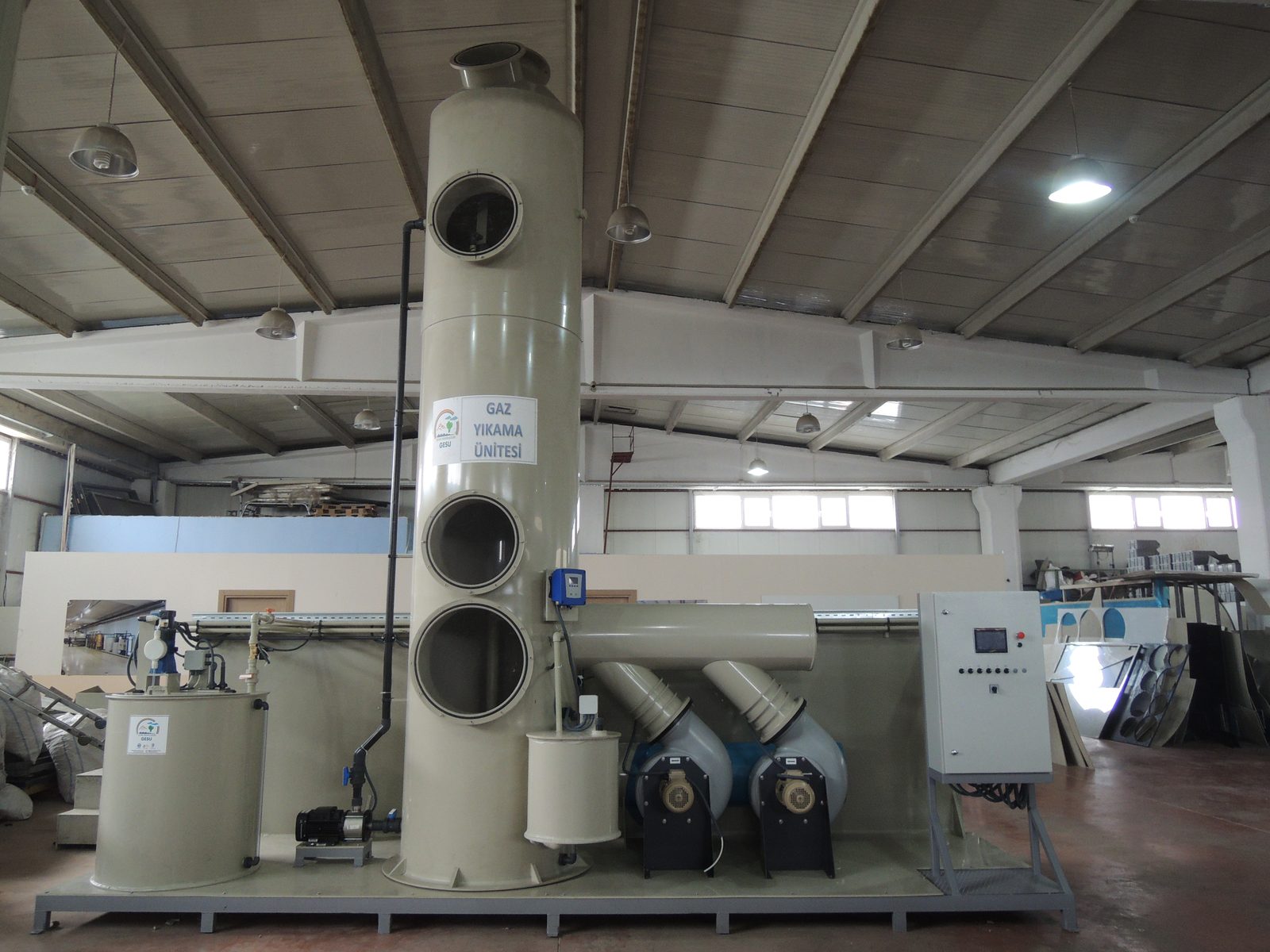
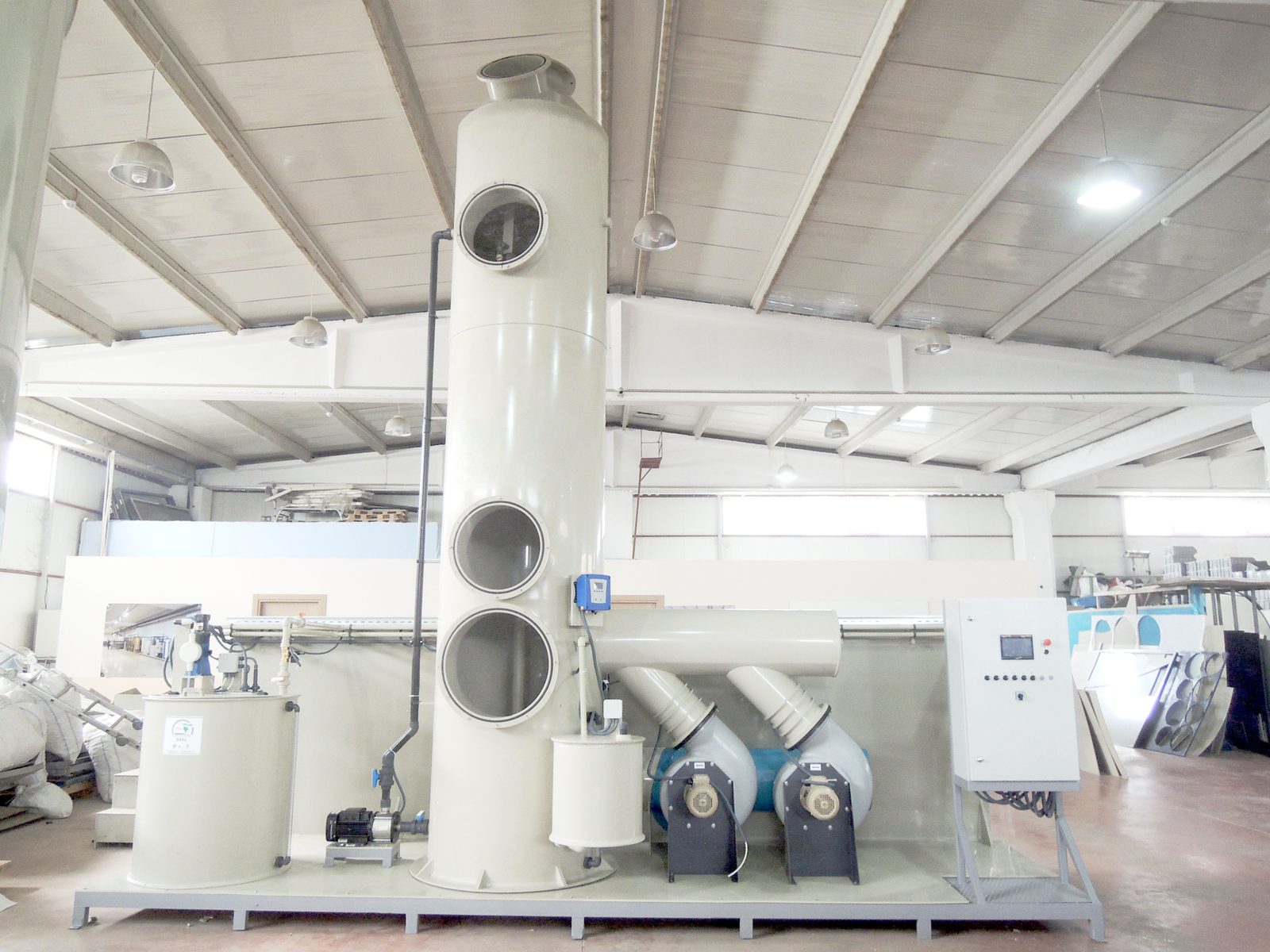
Gaziantep OIZ
Gas Scrubbing Unit manufacture
For Gaziantep OIZ we manufactured a Gas Scrubbing Unit (scrubber) for the odour and gas control of the central treatment plant: a complete skid consisting of the scrubber tower, chemical dosing tank, twin fan set and control panel. The frames above are from the workshop manufacture of this unit; the GESU label can be seen on the unit itself.
We know industrial zones from the inside
GESU's own manufacturing facility is located inside the Bursa Deri İhtisas ve Karma OIZ. For years we have also lived the sewer connection obligation, the relationship with the central plant and the operating tempo of an industrial zone as a tenant company ourselves — and that perspective feeds back into our designs from the field.
Industrial zone wastewater — frequently asked questions
What is the difference between the industrial zone's central treatment plant and a company's own pre-treatment?
They are two separate links of the same treatment chain. A company's pre-treatment brings that company's wastewater below the sewer connection (discharge) limits before it is released into the zone's sewer; the aim is to protect the central plant and the sewer network. The central (common) treatment plant then collects the mixed load coming from all companies and brings it down to the discharge standard for the receiving water body. If company pre-treatment is inadequate, the central plant meets shock loads and inhibition; that is why the two layers complement each other.
Our plant is connected to the industrial zone sewer; do we still have to install pre-treatment?
In most cases, yes. Industrial zones set discharge (connection) quality limits for every company connected to the sewer; parameters such as pH, oil and grease, COD, heavy metals and temperature are capped to protect the sewer and the central plant. In particular, streams that could poison (inhibit) the central biological treatment or block the sewer must be pre-treated at source. Your obligation is defined by your zone's connection permit document; we measure your wastewater and tell you which pre-treatment is required.
The flow and load of industrial zone wastewater vary widely — how does the central plant cope?
Industrial zone wastewater is variable by definition: shift changes, the production tempo of different industries and newly arriving companies swing the flow and the pollution profile through the day. The answer is sufficient equalization volume and modular units that can be commissioned in stages. Equalization buffers both flow and load; modular lines run flexibly as the zone fills up. The design reference is not the average but the peak and shock scenarios.
Our existing central treatment plant has become inadequate; is a capacity upgrade possible without demolishing it?
In most cases, yes. As industrial zones fill up, central plants exceed their original design flow; instead of demolishing everything, a bottleneck analysis is carried out. Equalization volume, aeration capacity, settling surface area and the sludge line are each assessed; capacity is increased by retrofitting or adding units targeted at the limiting stage. We make the most of existing structures wherever possible and avoid unnecessary investment — but we measure first and promise afterwards.
How are odour and gas problems solved at an industrial zone central treatment plant?
Mixed wastewater releases odorous gases such as hydrogen sulphide (H₂S) and ammonia (NH₃) at the screening, equalization, sludge and septic/anaerobic stages; these are a source of both environmental complaints and corrosion. The solution is to enclose the odour source and pass the collected gas through a gas scrubbing (scrubber) unit; H₂S and NH₃ are captured by acidic/alkaline scrubbing or by a biofilter. The Gas Scrubbing Unit we manufactured for Gaziantep OIZ is built exactly for this duty; you can see the site photos on this page.
Which standards apply to industrial zone wastewater discharge?
Two separate standards come into play. Companies connected to the sewer comply with the sewer connection / discharge quality control limits set by the industrial zone. The discharge of the zone's central treatment plant to the receiving water body is subject to the discharge standards defined for mixed industrial wastewater in the Turkish Water Pollution Control Regulation (SKKY). Which parameters are critical for you is determined by your discharge point and the permit conditions of your industrial zone.
Let's talk about the water in your industrial zone
Company pre-treatment, a central plant capacity upgrade or an odour problem — whichever it is, send us your analysis report; let our engineer assess the situation within 48 hours. No obligation to buy.