
Scrubbers & Gas Treatment
Chemical and biological washing towers for odour, acid and alkaline gas control — designed, fabricated and commissioned by GESU in our own factory in Bursa, Türkiye.
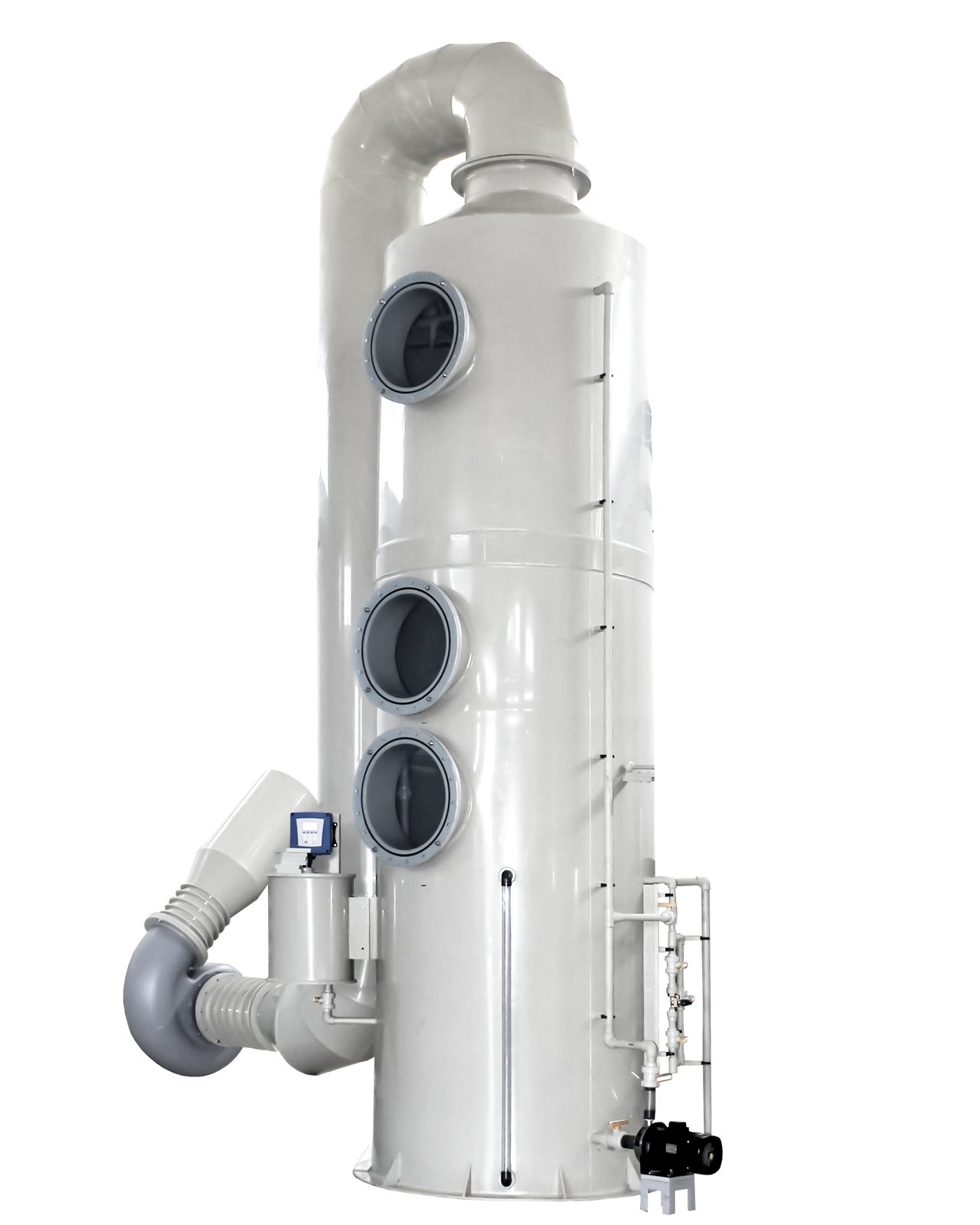
What is a scrubber and what does it do? A scrubber — a gas washing tower — brings a contaminated air or process exhaust stream into intimate contact with a washing liquid, so that the pollutant transfers out of the gas phase before the stream reaches the stack. In a chemical scrubber the washing liquid is dosed with an acid or an alkali (H₂SO₄, NaOH, NaOCl) and the pollutant is neutralised: this is how HCl, NH₃, H₂S, SO₂, HF and Cl₂ are captured. In a biological (bio) scrubber the same duty is carried out by microorganisms living on the packing, with almost no chemical consumption — the usual answer for organic odour. Removal of up to 99% is reached on acid and alkaline gases when the tower, the packing, the liquid-to-gas ratio and the dosing control are matched to the actual gas. GESU manufactures these units complete — tower, packing, fan, recirculation and dosing skid, PLC control — in its own factory, and has delivered them from municipal odour control duty to a 30,000 m³/h industrial gas treatment project.
When Do You Need a Scrubber?
Industrial gas treatment means cleaning the harmful gases (H₂S, NH₃, VOC, HCl, SO₂) and odour compounds released by a production process — or by the wastewater treatment plant itself — before they are discharged to atmosphere. In practice the trigger is one of four things: an odour complaint from the neighbourhood, an emission limit in the permit, a corrosion or occupational health problem inside the building, or a process exhaust that simply cannot be vented as it is.
GESU is specialised in the chemical (wet) scrubber and biological (bio) scrubber families; biofilter and activated carbon adsorption units complete the range. The methods are applied on their own or in combination, according to the type of emission, its concentration and the gas flow rate.
Wastewater Plants and Pumping Stations
- Odour control at pumping stations and screen buildings
- H₂S removal at the sludge dewatering unit
- Covering tanks and basins with extraction ventilation, so the odour is captured at source
- Municipal wastewater plants and collector systems
Industrial Emissions
- Acid fume from pickling and plating lines — metal finishing
- H₂S and process odour in tanneries
- Rendering, cooking and by-product odour in slaughterhouses and food plants
- Reactor and storage vents in chemical and pharmaceutical plants and petrochemicals
- Solvent and VOC laden exhaust from paint, lacquer and coating lines
Scrubber and Gas Treatment Types
GESU manufactures in two main scrubber families — the chemically dosed wet scrubber and the biological (bio) scrubber — in vertical or horizontal, packed or venturi configurations. Biofilter and activated carbon stages complete the range.
Chemical Packed Tower (Acid / Caustic)
Absorption of the gas into an acidic or alkaline washing liquid over a packed bed. HCl, NH₃, H₂S, SO₂ and HF duty, single or multi-stage, with automatic pH and ORP controlled dosing.
Biological Scrubber (Bio Scrubber)
H₂S and odour removal by microorganisms carried in the washing liquid. No chemical consumption, low operating cost; biological washing and trickling tower arrangements.
Biofilter
Removal of low concentration odour and VOC by microorganisms growing on a biological media bed. Low operating cost; vertical or horizontal designs.
Activated Carbon Adsorption
VOC, solvent and low concentration odour removal by adsorption. Granular or fibre media, used as a polishing stage after the wet or biological stage.
Venturi and Jet Venturi Scrubber
Venturi and jet venturi type washing towers; high efficiency washing where the gas carries dust or aerosols that would blind a packed bed.
Source Capture (Closed System)
Covering basins and tanks and adding extraction ventilation, so the odour never escapes into the plant or the neighbourhood. The scrubber only works properly if the capture works.
Pollutant Gases Removed
Hydrochloric Acid
Caustic (NaOH) washing
Ammonia
Acid (H₂SO₄) washing
Hydrogen Sulphide
NaOH or NaOCl washing — odour control
Sulphur Dioxide
Alkaline washing — flue gas treatment
Hydrofluoric Acid
NaOH or Ca(OH)₂ washing
Chlorine Gas
NaOH + NaHSO₃ washing
Chromic Acid Mist / Cr(VI)
Alkaline washing + mist eliminator
Cyanide Vapours
Controlled alkaline washing — segregated line
Mercaptans
Hypochlorite or biological stage
Organic Amines
Acid washing or biological stage
Volatile Organics
Activated carbon or biofilter polishing
Dust-laden Exhaust
Venturi / jet venturi — packing would blind
Chromic acid mist from hard chrome plating lines and cyanide vapours from plating baths need a segregated line and a properly sized mist eliminator — capturing the carried-over droplet matters as much as the absorption itself. Organic odour compounds are handled biologically or with a hypochlorite stage; low concentration VOC is normally polished on activated carbon. This table is indicative — the number of stages, the washing chemistry and the dosing strategy follow the actual gas analysis, the variability of the load and the emission limit that has to be met.
How a Scrubber Is Selected
A scrubber is not picked from a size chart. These are the questions our engineers work through before a tower diameter is put on paper — the answers come from your gas, not from a catalogue.
| Criterion | What is examined | Engineering note |
|---|---|---|
| Pollutant chemistry | Acid, alkaline, organic odour or a mixture | Decides the washing chemistry — or whether biology can do the job instead of chemicals. |
| Concentration and variability | Inlet concentration, peaks, batch or continuous release | A high or sharply varying load is what drives a design towards two or three stages instead of one. |
| Gas flow rate and temperature | Actual m³/h at operating conditions, humidity, temperature | Sets the tower diameter through the superficial gas velocity, and the height through the required contact time. |
| Body material | Corrosion compatibility, temperature, UV and outdoor exposure | PP and PVC for wet corrosive duty, GRP for large outdoor towers, stainless 316L where plastics are ruled out. |
| Packing type and bed depth | Random rings or structured packing, specific surface area, void fraction | Trade-off between mass transfer area and pressure drop; a dust laden gas will blind a fine packing. |
| Liquid-to-gas ratio | Recirculation rate, spray distribution, wetting of the bed | An unwetted or channelled bed is the most common reason a scrubber underperforms on site. |
| Dosing and control | pH and ORP setpoints, chemical type and strength, alarms | Automatic control keeps the removal steady and stops chemical from being wasted at low load. |
| Fan and ductwork | Static pressure across the bed and ducts, capture velocity at the hoods | Capture at source is part of the design; an undersized fan makes the best tower irrelevant. |
| Mist eliminator | Droplet carry-over at the outlet, demister type | Prevents a visible plume and chemical carry-over onto the roof and surrounding structures. |
| Blowdown and spent liquid | Where the saturated washing liquid goes, salt build-up in the loop | Usually routed to the wastewater plant — the gas problem must not simply become a water problem. |
Manufactured by GESU, in Our Own Factory
Tower, dosing skid, fan group and control panel come out of the same workshop — which is why the material and the packing can be chosen on engineering grounds rather than on what a supplier happens to stock.
PP / HDPE Fabrication
A 4 m PP/HDPE CNC butt-welding line joins plastic sheet in a full-length single seam — fewer joints in a tower body that has to stay tight under corrosive service.
Stainless and Carbon Steel
Robotic welding, CNC plasma and laser cutting, CNC press brake and plate rolling for stainless steel 316L bodies, skid frames, ducts and supports.
Body Material Options
PP, PVC, GRP or stainless steel 316L bodies. The choice follows the gas chemistry, the temperature and the exposure — not a standard product line.
Packing and Internals
PP Raschig rings, Pall rings or structured packing, spray distributors and mist eliminators — the packing material is selected according to the gas being treated.
Complete Skid Integration
Fan group, recirculation pump, chemical dosing tank and pipework assembled on a single frame, so the unit arrives on site as one piece instead of as a parts list.
PLC and Instrumentation
PLC control with pH and ORP sensors and an alarm set; dosing follows the measured value instead of a fixed timer.
All of this happens at our 5,000 m² site with 2,000 m² of covered production area in the Leather Specialization and Mixed Organized Industrial Zone, Bursa, Türkiye — a single location, with ISO 9001, ISO 14001 and ISO 45001 certified management systems. See the factory and the machine park →
Scrubbers We Have Built
Named projects, with what was actually in GESU's scope stated plainly.
Gaziantep OIZ — Gas Washing Unit
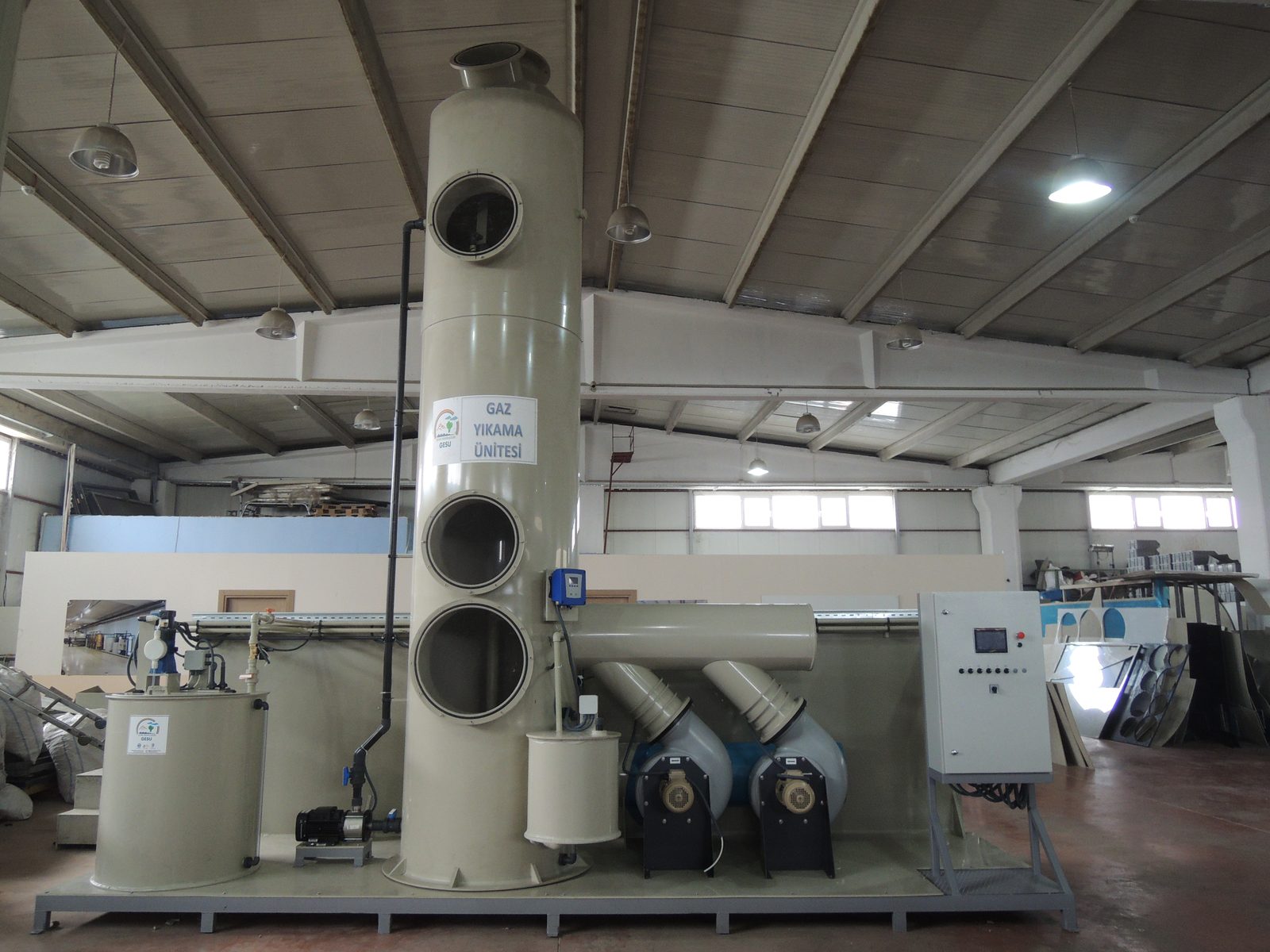
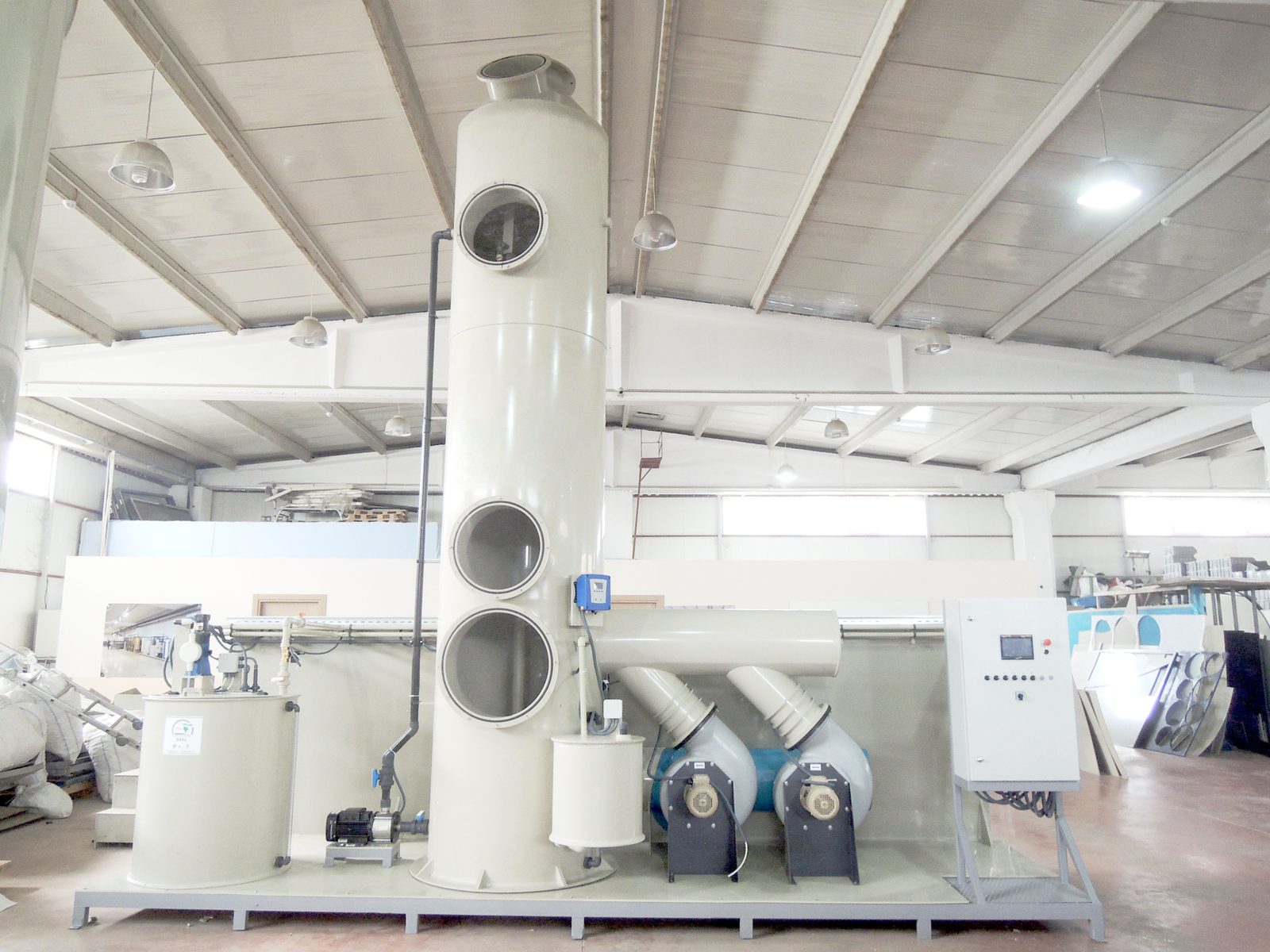
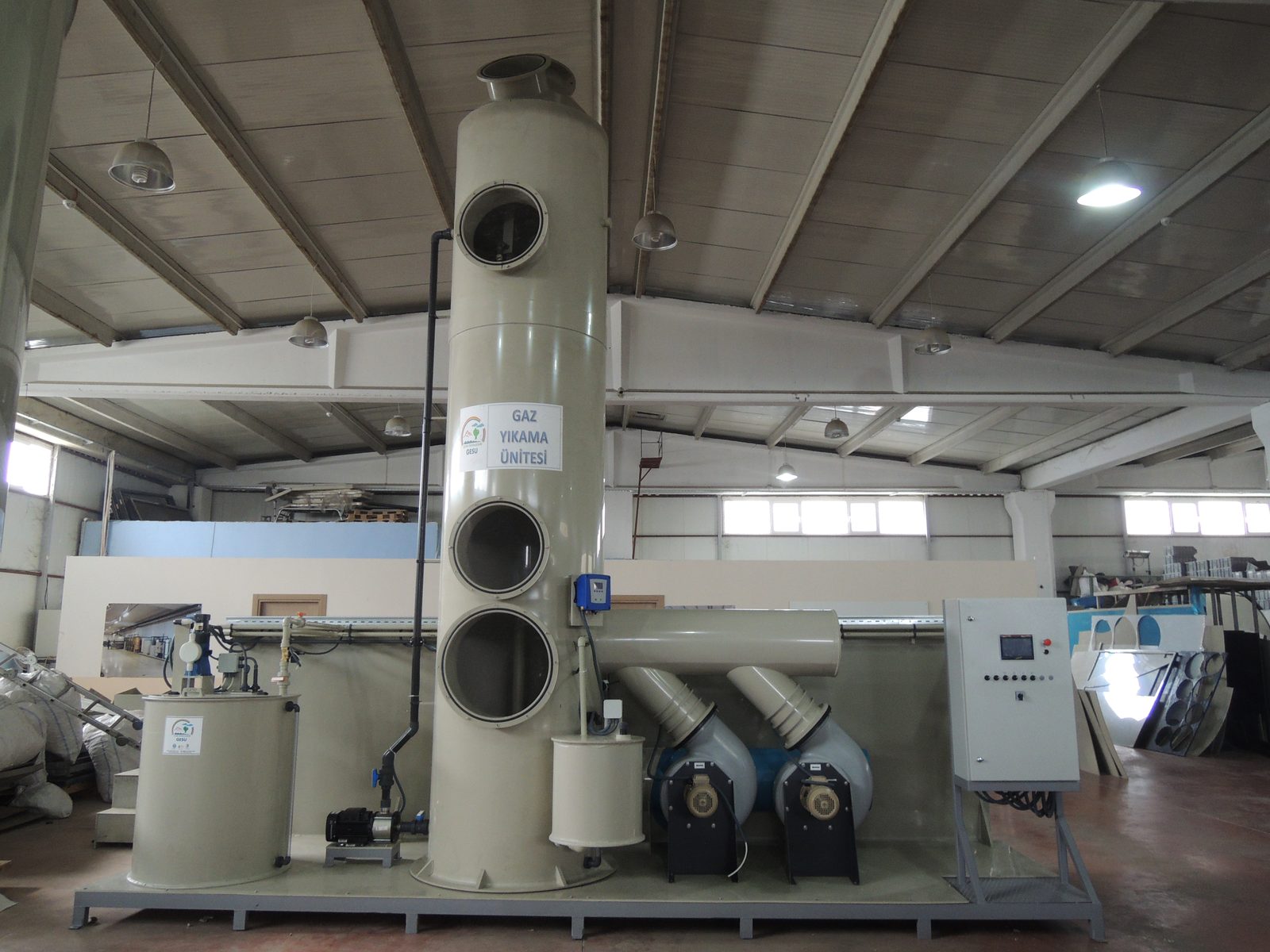
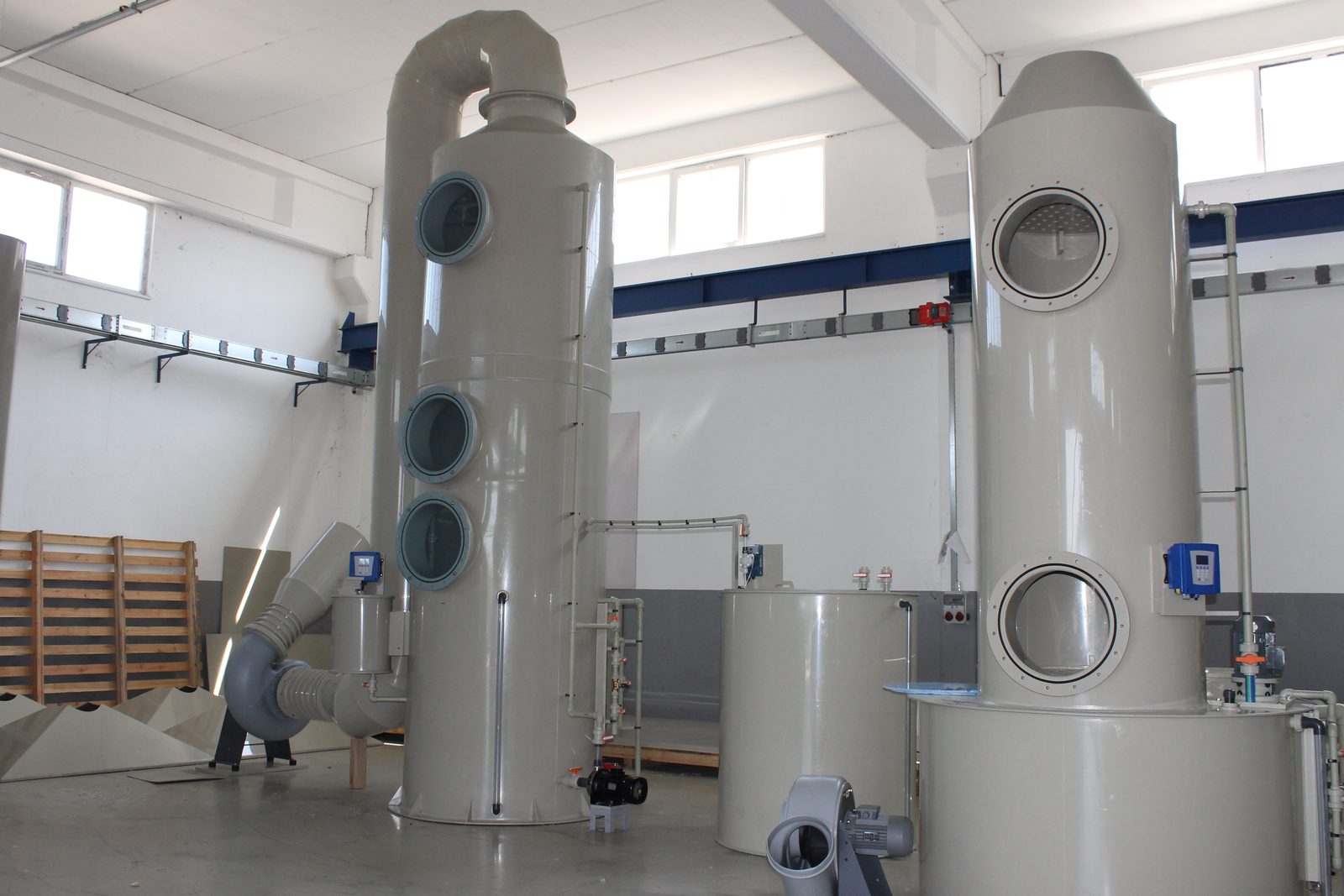
A complete gas washing unit manufactured for the odour and gas control of the zone's central treatment plant: scrubber tower, chemical dosing tank, twin fan group and control panel on one skid. The photographs below are from the workshop assembly of that unit.
Çanakkale Municipality — Odour Control Units
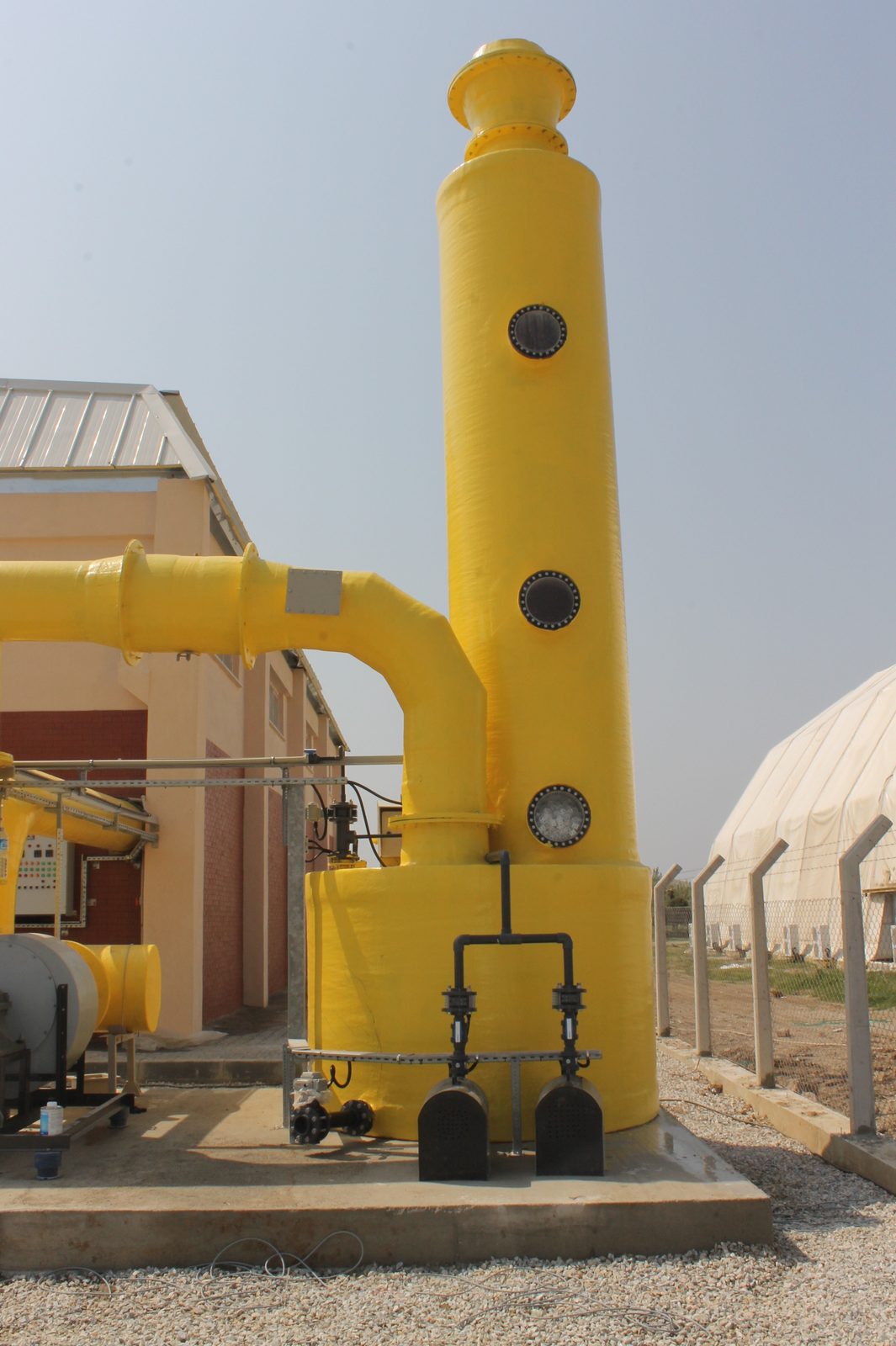
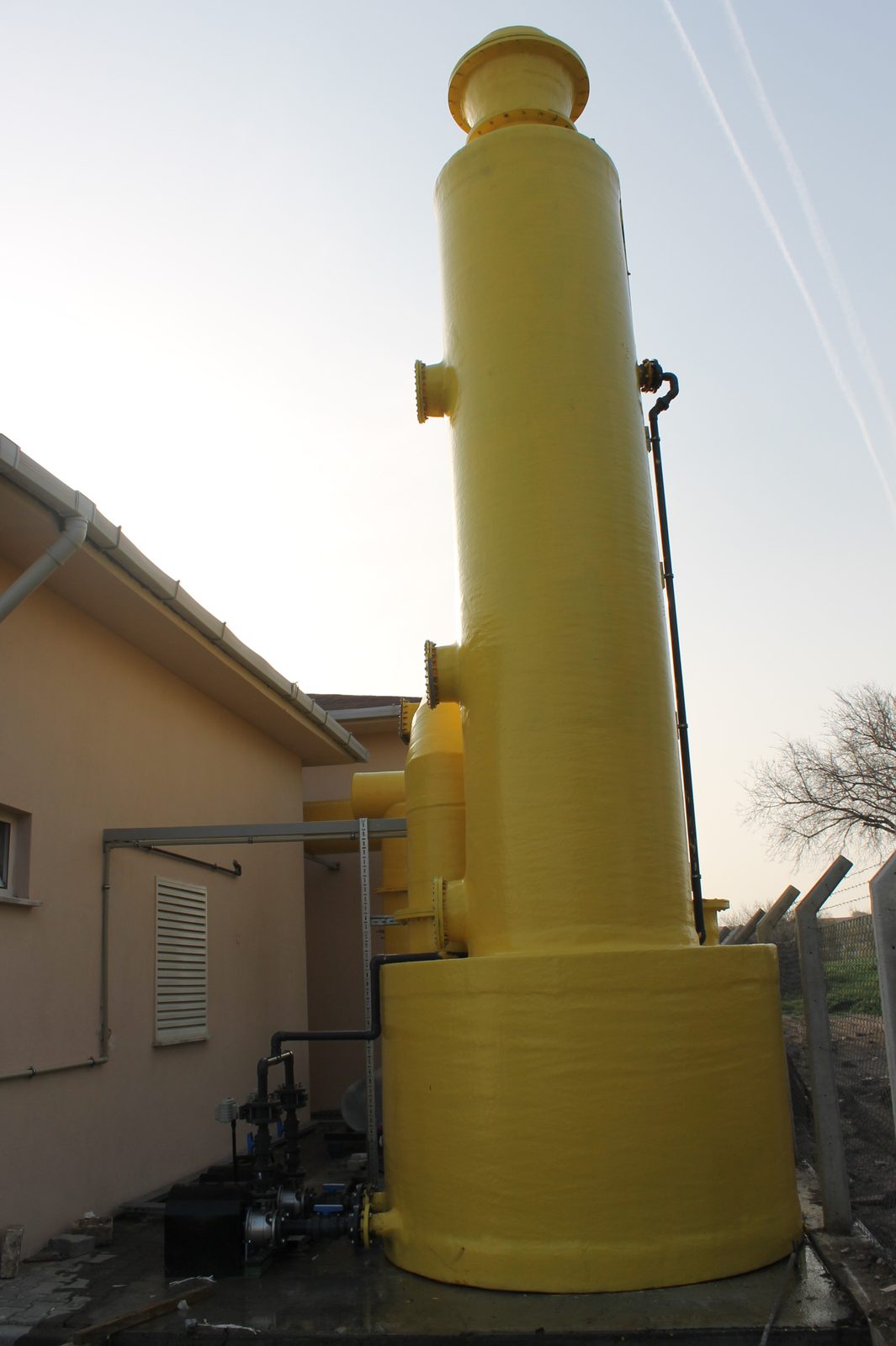
GRP gas washing (scrubber) units for the odour source points of the municipal treatment plant: manufacturing, erection and commissioning by GESU. The site photographs are from our 2014 archive.
Tecen, Ahal — Turkmenistan
Gas treatment (scrubber) project with a design gas flow of 30,000 m³/h — the largest single gas treatment unit in our reference list. See the references page for the full project record.
Related Technologies
Treatment technologies GESU engineers and manufactures.
Activated sludge combined with membrane filtration; effluent ready for reuse.
Fill-react-settle-decant cycles in a single tank; flexible for variable loads.
Carrier media biofilm process; capacity upgrade without enlarging the tank.
Chemical conditioning that turns colloids into settleable/floatable flocs.
High-pressure membrane desalination and polishing for water reuse.
Barrier against suspended solids and colloids; standard pre-treatment before RO.
Thickening, conditioning and dewatering — filter press, belt press, decanter.
GESU's flagship product: oil, grease and TSS removal, manufactured in-house.
What is included, what is not
In gas treatment the biggest difference between two quotations is rarely the tower itself — it is who carries the ductwork and the source capture. This is our typical split.
Included as standard
- Scrubber tower, packed bed, spray distributor and mist eliminator
- Recirculation tank and recirculation pump
- Fan group and tower connections
- Chemical dosing pump and injection assembly
- pH (and ORP where required) measurement and control panel
- Skid-mounted assembly — the unit arrives as one piece, not as a parts list
- Site erection, commissioning and operator training
- Installation/dimension drawing, operation and maintenance manual
- 2 years on mechanical equipment, 5 years on the body, 3 years on the packing
Available as an option
- Ductwork, hoods and source-capture fabrication
- Covering of basins and tanks with extraction connections
- Multi-stage arrangement (acid + alkaline + biological)
- Activated carbon polishing stage and biofilter
- Chemical storage tanks, bunded containment and eye wash
- Stack, platform, ladder and handrail fabrication
- SCADA integration, remote monitoring and emission logging
- Gas detection (H₂S/Cl₂), differential pressure and temperature measurement
- Upgrade to GRP or AISI 316L body, spare nozzle and probe kit
Buyer's scope
- Concrete plinth and civil works
- Power supply and main panel feed
- Fresh water supply and blowdown discharge connection
- Chemical supply and first filling
- Crane/forklift and site assistance during erection
- Emission measurement, environmental permit and official procedures
This split is indicative. Scope is written item by item in every quotation and fixed by contract; items can move between "included" and "optional" per project.
What we do not do in gas treatment
What a supplier cannot do matters as much as what it can. The following are outside our scope — we would rather you read it here than discover it during a quotation.
NOx (nitrogen oxide) abatement
We have never delivered a NOx abatement system and we have no reference in this field. The technical reason is straightforward: nitric oxide (NO) is only slightly soluble in water, so it cannot be captured by conventional wet scrubbing — it requires pre-oxidation or a separate technology such as SCR/SNCR. Other companies work in this family; if this is what you need, we are not the right address.
Wet electrostatic precipitators (WESP)
We do not manufacture this equipment family, in which very fine particulate and aerosols are captured by electrostatic charge. For dust and aerosol laden gas our answer is the venturi scrubber; ultra-fine particulate duty beyond that is outside our scope.
Our principle: when asked for something outside our scope, we do not say "we can do that". We say we do not, and where we can, we point you in the right direction. A treatment plant is an investment that has to run for fifteen to twenty years; a gap not mentioned at the start costs far more in the middle.
What to send us for a scrubber quotation
In gas treatment the accuracy of a quotation depends on knowing what the gas actually is. With the information below in hand we quote in a single round. If you do not have an emission measurement, write anyway — we will tell you which measurement is needed.
- 1Gas flow rate — actual m³/h at operating conditions (how many hoods, how many capture points)
- 2Pollutant type and concentration — emission measurement report if available (ppm or mg/Nm³)
- 3Gas temperature, humidity and dust/aerosol content
- 4The target: an emission limit in the permit, or stopping a neighbourhood odour complaint
- 5Release pattern: continuous or batch; operating hours per day
- 6Source points: which tanks or basins are to be covered, distances and elevations between them
- 7Any existing ductwork or fan — dimensions and photographs
- 8Where the unit will stand: indoors or outdoors, area constraint, required stack height
- 9Where the saturated washing liquid will go — is there a wastewater treatment plant on site
- 10Electrical supply: voltage/frequency, existing panel, SCADA integration required
From the Field & the Workshop
Not stock imagery — our own manufacturing, our own sites.
Let's Talk About Your Project
With 30 years of experience, let's define the most suitable solution for your project together.
Scrubbers — Frequently Asked Questions
We have gathered the questions our customers ask most often. If you can't find the answer you're looking for, get in touch with us.
Which gases and odours can a scrubber remove?
A wet scrubber removes gases that dissolve or react in the washing liquid. Acid gases such as HCl, SO₂, HF and Cl₂ are captured in an alkaline stage; ammonia (NH₃) is captured in an acidic stage; hydrogen sulphide (H₂S) and the mercaptan and amine compounds behind most odour complaints are captured with caustic or hypochlorite washing, or biologically. Low concentration VOC and residual odour are usually polished with a biofilter or an activated carbon bed rather than with a wet stage. Dust and aerosol loaded streams are handled with venturi or jet venturi type washing.
Chemical scrubber or biological scrubber — which one should be chosen?
The pollutant decides. Where the gas is inorganic and the concentration is high or variable — plating and pickling exhausts, chemical process vents, ammonia from food plants — a chemical scrubber with automatic pH or ORP controlled dosing is the robust choice. Where the load is an organic odour at low and reasonably steady concentration — pumping stations, screen buildings, sludge dewatering rooms — a biological scrubber or a biofilter does the same job with almost no chemical consumption and lower operating cost, but it needs a stable, acclimated biomass. On sites with both an acid or alkaline peak and a residual odour, the two are combined in stages.
What gas flow capacities does GESU manufacture scrubbers for?
GESU manufactures scrubber systems for gas flows in the 500 to 100,000 m³/h range. Acid, caustic and hypochlorite (NaOCl) washing stages and multi-stage (up to three stage) arrangements are available, and the packing material — PP, PVDF or ceramic — is selected according to the gas being treated. The largest single gas treatment unit delivered so far is the 30,000 m³/h scrubber project in Tecen, Ahal, Turkmenistan.
Which body material should a scrubber be built from?
The body material follows the chemistry, the temperature and the expected service life — it is an engineering decision, not a stock decision. Polypropylene (PP) and PVC are the usual choice for wet, corrosive, ambient temperature streams such as H₂S, HCl and NH₃ duty; GRP is used where a large diameter, weather exposed tower is needed; stainless steel 316L is used where temperature, solvent content or mechanical loading rules out plastics. GESU builds all of these in-house, so the material can be chosen on engineering grounds.
Does GESU manufacture its scrubbers in its own factory?
Yes. The towers, dosing tanks, skids and control panels are fabricated at our own 5,000 m² facility (2,000 m² covered) in Bursa, Türkiye, using robotic welding, CNC plasma and laser cutting, a CNC press brake and a 4 m PP/HDPE CNC butt-welding line. Delivered examples include the complete gas washing unit built for Gaziantep Organized Industrial Zone, the GRP odour control units installed and commissioned at the Çanakkale Municipality treatment plant in 2014, and the 30,000 m³/h gas treatment project in Tecen, Ahal, Turkmenistan.